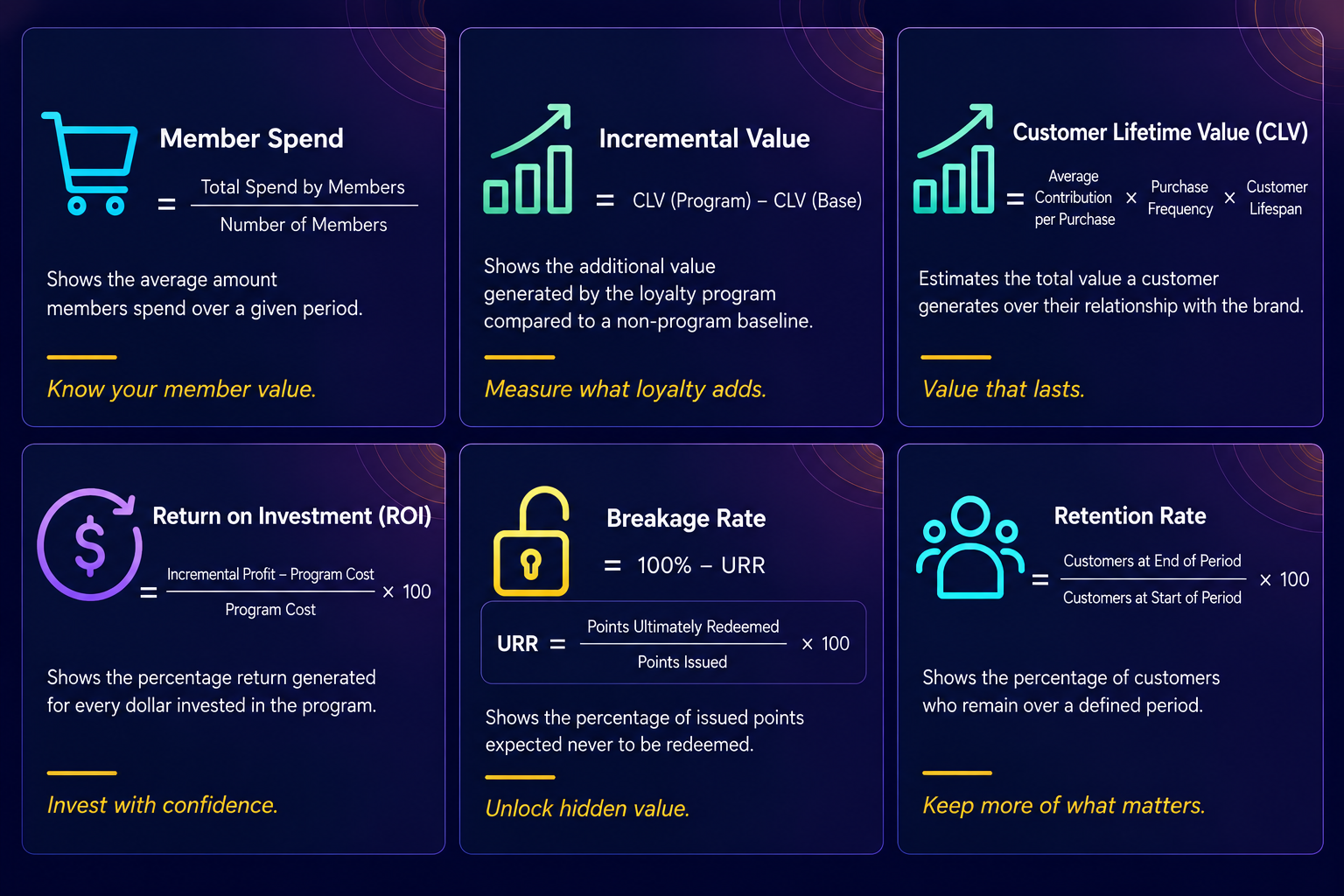

The Loyalty Metrics Cheat Sheet
Loyalty has no shortage of metrics — but knowing the numbers is only the beginning.
From Member Spend and CLV to Incremental Value, ROI, Retention and Breakage, Loyalty Economics helps loyalty professionals understand what each measure really tells you, how the numbers connect, and how to move from measurement to meaningful commercial contribution.
✺ Dictionary of Key Terms ✺
-
The monetary value assigned to a loyalty point for accounting purposes. This is typically the estimated cost incurred by the business when a point is eventually redeemed by the customer.
-
The acquisition cost of issuing a point to a customer when they earn it. This includes:
The immediate cost of funding the point (e.g., if you prepay a partner for points)
Any associated promotional costs
The anticipated redemption liability
-
The actual expense incurred when a customer redeems a point for a reward.
This is often higher than the earn cost because it includes the cost of fulfilling the reward, taxes, and logistics. -
Return on Investment (ROI) is a critical metric when evaluating the effectiveness of loyalty programs. It helps businesses assess whether the resources invested in these programs—such as rewards, marketing, and technology—are generating measurable benefits in terms of customer retention, increased sales, and long-term brand loyalty.
By calculating ROI, companies can determine if their loyalty initiatives are truly fostering a sustainable relationship with customers, or if adjustments are necessary to optimise performance. A positive ROI not only justifies the continued investment in loyalty strategies but also helps in refining them to create more value for both the business and the customer, ultimately driving growth and enhancing competitive advantage.
-
Incremental margin in loyalty programs refers to the additional profit earned from members over and above what they would have spent regardless, after accounting for program costs. It demonstrates the program’s financial value—not just revenue growth—by comparing member and non-member behaviour or using control groups to isolate genuine changes in customer behaviour.
-
The financial obligation a business recognises on its balance sheet for all outstanding (unredeemed) points that customers hold. This reflects the estimated future cost to honour these points when redeemed.
-
The difference between the value perceived by the customer (the perceived value of the point) and the actual cost to the business. This spread is often what makes loyalty programs profitable: members feel they’re receiving high value, while the business fulfills at a lower cost.
-
Breakage refers to the percentage of loyalty points or rewards that are issued to members but are never redeemed.
Why Breakage Happens
Members forget or are unaware of their points.
Redemption thresholds are too high.
Rewards are not attractive or relevant.
Accounts become inactive or lapse before use.
Program rules or expirations limit usability.
-
Incremental sales in loyalty programs refer to the additional revenue driven directly by member behaviour that wouldn’t have occurred without the program. This uplift comes from motivating customers to buy more often, spend more per visit, or move into higher value tiers. The result is stronger Customer Lifetime Value (CLV), a clearer competitive edge, and—on average—an annual revenue increase of around 12–18% from members.